icon design

Jonathan Follett’s recent article in UXMatters, Seeing the World in Symbols: Icons and the Evolving Language of Digital Wayfinding covers the history of icon design with links to important resources such as the AIGA universal graphic system and the icon archive at GUIdebook: Graphic User Interface gallery.


“
In Steve Caplin’s book Icon Design, Susan Kare, the artist who created the icons for the original Mac desktop and applications said:“In general, I believe that icons should work a bit like traffic signs; they should convey information without distracting the user, without competing with the data in an application. Ideally, they should suggest something about the functionality. If it is not completely evident, then the function should be easy to remember if the user is told only once.”

[…]

Today, two decades after their advent, icons unnecessarily clutter the desktops of new computers and the toolbars of applications. Increasingly, rather than performing a user-centered wayfinding function, they instead serve a corporate-centered branding function, with application icons becoming tiny billboards for Microsoft®, Adobe®, and their fellow competitors. We’ve turned our virtual spaces into the visual equivalent of the Vegas strip, but without the fun. If the primary purpose of an icon is to appropriately represent an action and help a person accomplish a task quickly, as this visual clutter increases, icons are increasingly failing at that task.

source: Seeing the World in Symbols: Icons and the Evolving Language of Digital Wayfinding. UXMatters, December 18, 2006
”


In addition to this, there are the following ISO standards for icons

ISO/IEC 11581:2000 Information technology — User system interfaces and symbols — Icon symbols and functions —

  • Part 1: Icons — General
  • Part 2: Object icons
  • Part 3: Pointer icons
  • Part 4: Control icons
  • Part 5: Tool icons
  • Part 6: Action icons

ISO/IEC 18035:2003 Information technology — Icon symbols and functions for controlling multimedia software applications
ISO/IEC 18036:2003 Information technology — Icon symbols and functions for World Wide Web browser toolbars
ISO/IEC TR 19764:2005 Information technology — Guidelines, methodology and reference criteria for cultural and linguistic adaptability in information technology products
ISO/IEC 24738:2006 Information technology — Icon symbols and functions for multimedia link attributes 

[Edited from Photomedia Forum post by T.Neugebauer from Dec 2006]

Information Design and Architecture

‘Information Design’ also known as “Information Architecture” (IA) and many other names, but we already knew from Gottlob Frege that a symbol can denote many senses…

The first book on Information Design that I read was this book, published in 2000:
Information Design

edited by Robert Jacobson.

I saw it at the MIT bookstore, and couldn’t resist…

One of the first online journals about usability is Boxes and Arrows, and I had the opportunity to attend a presentation and meet its founder Christina Wodtke…I think she was one of the founders of Information Architecture Institute… the presentation consisted largely of a film featuring interviews with various ‘information architects’…
the opportunity was partly the result of the recent IA Summit which just happened to take place in Montreal… one of the interesting applications
discussed at the summit was Flickr Photo Sharing…

Christina published a book on IA in 2002
Information Architecture: Blueprints for the Web 

Information design and information architecture is interesting to me, although it is a little bit like ‘informatics’, the meaning of this seems to be continually redefined with subtle nuances. the following list of disciplines are closely related:

I suppose the inter-disciplinary nature of information makes it difficult to label…

I just run across this article, and thought it was an interesting parallel between architecture and information architecture… i always thought that these have a lot in common…

We Are All Connected: The Path from Architecture to Information Architecture, by Fu-Tien Chiou

For architectures of large scale websites there is

Information Architecture for the World Wide Web: Designing Large-Scale Web Sites
wirtten by Louis Rosenfeld, Peter Morville. This 2nd edition was published in 2002.

Peter Morville published a new book on IA in 2005:
Ambient Findability

You can read an interview with Peter Morville in Boxes and Arrows by Liz Danzico

Designing Interfaces: Patterns for Effective Interaction Design

by Jenifer Tidwell, the book site (http://designinginterfaces.com/) offers a good summary of the contents. Jenifer Tidwell first presented a UI pattern language.

[Edited from Photomedia Forum post by T.Neugebauer from April 18, 2005 – November 18, 2006]

Grigory Perelman

Grigory Perelman, mathematician that recently offered a solution to Poincaré’s conjecture has an impressive list of prizes that he did not accept: the Fields Medal, the $1 million Millennium Prize, the prizes from the International Congress of Mathematicians in Madrid, a prize from the European Mathematical Society.

“Perelman has said: “If everyone is honest, it is natural to share ideas.”
“[…]Of course, there are many mathematicians who are more or less honest. But almost all of them are conformists. They are more or less honest, but they tolerate those who are not honest.” He has also said that “It is not people who break ethical standards who are regarded as aliens. It is people like me who are isolated.”

source: The New Yorker – MANIFOLD DESTINY
A legendary problem and the battle over who solved it.

”

“
“If anybody is interested in my way of solving the problem, it’s all there — let them go and read about it,” he told The Telegraph. “I have published all my calculations. This is what I can offer the public.”

source: New York Times – The Math Was Complex, the Intentions, Strikingly Simple
”

[Edited from Photomedia Forum post by T.Neugebauer from Nov 12, 2006]

User-Centered Design

I have been reading about user-centered design for years, and find that the amount of web sites and sources about the subject is overwhelming. There are some key developments in the field that can get buried under all that information, such as the existence of relevant ISO standards:

ISO 13407 – Human-centered design processes for interactive systems (1999)

ISO 9241 (part 11) – Ergonomic requirements for office work with visual display terminals (VDTs) : Guidance on usability (1998)

The Human Factors Research Group (HFRG) at University College Cork (Ireland) has a good introduction to ISO 13407. Jurek Kirakowski, director of HFRG also wrote Using ISO 13407 as a guide to personal knowledge and competence.


“
 
”


ISO 9241 (part 11) defines usability as


“Usability
The effectiveness, efficiency, and satisfaction with which specified users achieve specified goals in particular environments.Effectiveness
The accuracy and completeness with which specified users can achieve specified goals in particular environments.Efficiency
The resources expended in relation to the accuracy and completeness of goals achieved.Satisfaction
The comfort and acceptability of the work system to its users and other people affected by its use. ”


see also:
usabilitynet.org – ISO 13407 
usabilitynet.org – International standards for HCI and usability


some more interesting articles on usability:

Web-Based User Interface Evaluation with Questionnaires by Gary Perlman

Usability measurement in context (PDF) by
Nigel Bevan and Miles Macleod (Behaviour and Information Technology, 13, 132-145 (1994), National Physical Laboratory, Teddington, Middlesex, UK) In this study, the profile of perceived usability was subdivided into 5 subscales: Affect, Efficiency, Helpfulness, Control, and Learnability.


“From a user’s perspective, the time he or she spends carrying out the task, or the effort
required to complete the task are the resources he or she consumes. These two types of
resources produce two different definitions of efficiency:Temporal Efficiency = Task Time = Effectiveness
Human Efficiency = Effort (e.g.: cognitive workload) = EffectivenessFrom the point of view of the organisation employing the user, the resource consumed is
the cost to the organisation of the user carrying out the task, for instance:¥ The labour costs of the user’s time
¥ The cost of the resources and the equipment used
¥ The cost of any training required by the user

In this case, efficiency can be stated as:
Economic Efficiency = Effectiveness

[…]

Measures of satisfaction describe the perceived usability of the overall system by its
users and the acceptability to the system to the people who use it and to other people
affected by its use. Measures of satisfaction may relate to specific aspects of the system
or may be measures of satisfaction with the overall system.
”


see also:
usability.gov – official U.S. Government Web site managed by the U.S. Department of Health & Human Services

Current practice in measuring usability: Challenges to usability studies and research by Kasper Hornbæk
International Journal of Human-Computer Studies
Volume 64, Issue 2, February 2006, Pages 79-102
http://dx.doi.org/10.1016/j.ijhcs.2005.06.002
open access version: http://www.cs.chalmers.se/idc/ituniv/kurser/09/hcd/literatures/Hornbaek%202006%20usability%20measurement%20methods.pdf

[Edited from Photomedia Forum post by T.Neugebauer from Sep 22, 2006 ]

constructive mathematics and the Markov principle

Someone asked me recently about constructivism in mathematics, which led me to the Douglas Bridges’ article in Stanford Encyclopedia of Philosophy on constructive mathematics. What is constructivism? It is a philsophy of mathematics that “asserts that it is necessary to find (or “construct”) a mathematical object to prove that it exists” (wikipedia), as opposed to classical mathematics where it is enough to assume that the object does not exist and derive a contradiction.

In the Bridges’ article, I found a priceless illustrative example, the Markov Principle (MP):

“
For each binary sequence (an), if it is contradictory that all the terms an equal 0, then there exists a term equal to 1.

[…]

Markov’s Principle represents an unbounded search: if you have a proof that all terms an being 0 leads to a contradiction, then, by testing the terms a1,a2,a3, in turn, you are guaranteed to come across a term equal to 1; but this guarantee does not extend to an assurance that you will find the desired term before the end of the universe. ”

[Photomedia Forum post by T.Neugebauer from  May 6, 2006 ]

Critical Inquiry – Special Issue on Photography

The  Summer 2012 issue of Critical Inquiry is devoted to the philosophy of photography, in particular, questions of automatism and agency. The editors of the Special Issue on Photography, Diarmuid Costello and Margaret Iversen, point out that two key papers published in Critical Inquiry have had a particular impact on the debate in philosophy of photography: Roger Scruton’s argument that photography is not a representational art in “Photography and Representation” and Kendall Walton’s “Transparent Pictures.”

The Contributors to the issue include philosophers, photographers, and art historians: Carol Armstrong, Diarmuid Costello, Margaret Iversen, Robin Kelsey, Susan Laxton, Dominic McIver Lopes, Patrick Maynard, and Jeff Wall.

Unfortunately, the issue is not available open access.

[Edited from Photomedia Forum post by T.Neugebauer from Sep 27, 2012 ]

Sublime Limits of Representation

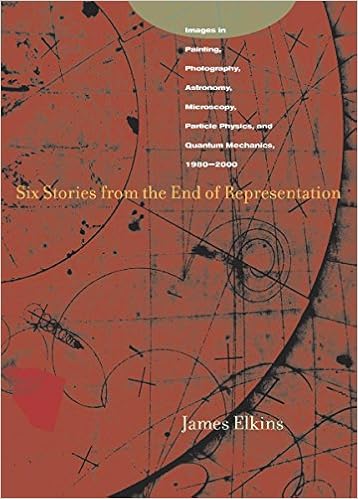
Truly interdisciplinary works of high quality are very rare, because they require the kind of intellectual discipline and curiosity that allows for understanding and insight into not one, but many disciplines that are customarily separated by theoretical and linguistic differences. The recently published James Elkins’ Six Stories from the End of Representation is a fascinating look at the limits of representation in art and science with chapters devoted to painting, photography, astronomy, microscopy, particle physics and quantum mechanics.

The motivation for the book is the writing of a work that does not favor either art nor science at the expense of the other – instead of looking at science through the language and methods of the humanities (or vice-versa), each is treated with their respective conventions.


“Serious art and serious science remain very different, and people who study their connections end up looking at special cases that can’t, I think, add to a plausible account of wider movements and ideas.

(As usual, Tim Clark has the best phrase for this—it’s somewhere in Farewell to an Idea—he says “art usually dines very poorly on the leavings of science.”)

So my idea in this book is to stop finding causal connections between art and sciences. Instead I’m trying to find ways of talking about scientific and non-scientific images together, without special pleading or popularization.

In terms of the “science wars” (the book’s second ancillary purpose): it seems essential to me to try not to simplify either the relevant science or the art.

There has been a bit too much low-level squabbling recently between scientists and humanists, especially since Alan Sokal’s hoax and his subsequent book, and Bruno Latour’s playful, and, I think, somewhat irresponsible rewriting of special relativity.

source: Report on a Book Project Titled How Pictures Die: Six Stories from the End of Representation by James Elkins”


The first chapter begins with the concept of sublimity, most notably, Immanuel Kant. Kant described the sublime as a mathematical or dynamic experience in his Critique of Judgement. Elkins returns to Kant’s theory throughout the book, the dynamic sublime,


“One of Kant’s examples, and still the standard one, is a stormy ocean. By sheer force, the ocean denies us the freedom to act or to move as we will. It is Kant’s idea that a person confronting a tumultuous sea will first be paralyzed and humbled, and then begin thinking of how people avoid drowning: how they navigate the ocean, and how they are, in the end, independent of it. That train of thought is essentially a defense, and it brings with it a comforting sense of detachment […] For Kant, the feeling of the dynamic sublime arises from the contrast between two mental states: first the abject dependence on unmasterable forces, and then the freedom that comes with the awareness that thinking is a different kind of experience.

James Elkins’ Six Stories from the End of Representation ( p.28 )”


and the mathematical sublime,


“Kant defines it as an experience of something unencompassable, so large that it exceeds our capacity for comprehension. His example, the starry sky, is also one of my subjects in this book. At first, confronted with the starry sky, a viewer is dazzled, confused, and – again – humbled. Then she tries to employ some concept to help her comprehend the incomprehensible heavens: say for example the concept of infinity. The viewer says to herself, “This is infinite,” and for a moment she is comforted. But there follows a third moment (Kant’s analysis is typically intricate) when it becomes clear that the “manifold” object is too expansive to be understood. It cannot be gathered under a single concept, a single intuition. And further: the concept itself, in this case infinity, is not directly experienced, but somehow known. There follows a fourth and final moment when the viewer realizes that her innate capacity to reason is what drives the desire to encompass an unencompassable object with an inadequate concept. Even though the attempt to understand the object fails, the viewer becomes aware of a mysterious, inbuilt capacity to try to match her imagination to objects: a capacity that includes the very idea of a fully adequate concept even though no such concept can be imagined. The game is lost, but she knows that she has a “supersensible” faculty, which allows her to think about such things as infinity and the correspondence between inadequate concepts and unknowable objects. “The bare capacity of thinking this infinite without contradiction,” Kant says, “requires in the human mind a faculty that is itself supersensible [das selbst übersinnlich ist].” That is the sublime: a pleasure that comes from displeasure – the displeasure of realizing that the imagination has been, and will always be, defeated.

James Elkins’ Six Stories from the End of Representation ( p.29 )”


Elkins emphasizes that the book is philosophy only in the sense that philosophy is sophophagic (“it eats other disciplines”) and the theme of of the book, representation, is a concept of study in philosophy; however, he avoids what he terms “philosophic vocabulary of representation” such as Vorstellung, Darstellung, Idea, simulacrum, eidolon, imago. I can understand the temptation to focus on the language of the philosophy of representation in any attempt to find a connecting principle between art and science – but that would result in another philosophy book to be read by professional philosophers, whereas Elkins intention was to create a book to be read by scholars in the humanities and natural scientists alike. I think that he succeeds in this.

[Photomedia Forum post by T.Neugebauer from  Sept 7, 2008 ]

Carl Jung’s The Undiscovered Self

I was drawn to my first C.G. Jung book by the cover, silver material that served as a mirror. When I first picked up the 1979 edition of The Undiscovered Self at The Word bookstore on Milton Street, I found myself reflected in it. Although tacky somehow, it was nevertheless a clever play on the theme of self-discovery. Time magazine used the same trick on their cover when they recently announced that the person of the year is you.

The inside blurb calls this short book Jung’s “most prophetic – and most influential”. It has certainly proved to be somewhat prophetic of today’s ongoing debate about religion and science. The Undiscovered Self speaks of a growing rift between faith and knowledge, a contrast that “has become so enormous that one is obliged to speak of the incommensurability of these two categories and their way of looking at the world.”

Jung avoids the common pitfall of today which seems to reduce the debate to caricatures completely ignorant of the opposing point of view. He distinguishes between religion which expresses a subjective relationship to certain metaphysical factors and a creed which merely gives expression to a collective belief. Religion is understood in the broad sense, including the relationship of the individual to the metaphysical and the world of dreams, feelings and intuitions. Science, on the other hand, is the rationalistic, statistical and theoretical part of understanding. Self-knowledge, according to Jung, cannot be achieved by abandoning either of these facets.

Rationalized scientific theories are by definition generalized truths that attempt to go beyond the individual case, yet self-knowledge requires special attention to those things that are unique, individual and defy generalization


“Since self-knowledge is a matter of getting to know the individual facts, theories help very little in this respect. For the more a theory lays claim to universal validity, the less capable it is of doing justice to the individual facts. Any theory based on experience is necessarily statistical; that is to say, it formulates an ideal average which abolishes all exceptions at either end of the scale and replaces them by an abstract mean. This mean is quite valid, though it need not necessarily occur in reality. ( p.8 )”


Statistical methods show us an ideal average, not empirical reality; distinctive facts are individual. The real picture could consist of nothing but exceptions,

“There is and can only be self-knowledge based on theoretical assumptions, for the object of self-knowledge is an individual – a relative exception and an irregular phenomenon. ( p.9 ) ”


The individual cannot be understood as a “recurrent unit” but as something unique and singular. Jung admits that man is also a “member of a species” to be described as a statistical, comparative unit from which “all individual features have been removed.” This gives us knowledge about the human species, but it does not give us understanding of the individual since it is these ‘removed’ features that are necessary for understanding.

It is possible to store and accumulate knowledge in the form of memories. Understanding cannot be stored in the same way because understanding refers to events and experiences, of which only the memories can be partially preserved. Perhaps it is these memories that are the basis of our knowledge, but the relationship to the experience of understanding is ultimately unknown.

When I attended Marvin Minsky’s presentation on artificial intelligence at Concordia University last year, he was unequivocal about the fact that “experience” is much too ambiguous a term to be used in any definition of understanding. He went on to claim that hearing the term ‘experience’ is a signal for him that the person uttering it is worthy only of dismissal. This was not the most controversial of his statements that afternoon: he seemed to go out of his way to insist that religion is to blame for most of the world’s failures, including stagnating progress in science and technology and the failure to deliver real artificial intelligence. For Minsky, understanding is reducible to neural and semantic nets, representations of structure and function. According to his view, insight, illumination and creativity are all “common sense terms”, like consciousness itself, along with empathy, moral reflection and sense of identity; all are in reality too ambiguous and when correctly defined, reducible to structure and function. He seemed to blame religion itself for the fact that his structure-functional definitions of these terms have yet to take over the normative meaning.

Jung writes of the incompleteness of the scientific view of an individual

“Judged scientifically, the individual is nothing but a unit which repeats itself ad infinitum and could just as well be designated with a letter of the alphabet. ( p.11 ) ”


Czeslaw Milosz’ Captive Mind does precisely that, designating the characters not by the names of the individuals on which the stories are based, but by the letters of the Greek alphabet Alpha, Beta, Gama and Delta. Jacques Ellul argues that propagandists address their influence to individuals understood solely as interchangeable units, he writes in the first chapter of Propaganda: On the Formation of Man’s Attitudes,

“Modern propaganda reaches individuals enclosed in the mass, yet it also aims at a crowd, but only as a body composed of individuals. What does this mean? First of all, that the individual is never considered as an individual, but always in terms of what he has in common with others, such as his motivations, his feelings, or his myths. He is reduced to an average; and except for a small percentage, action based on averages will be effectual. (p. 6) ”


With books by Dawkins and Hitchens on the best seller lists, ‘scientific’ attacks against religion have become a common part of popular culture. Jung points out that at the time of his writing The Undiscovered Self, the basic conviction of the day is becoming “increasingly rationalistic”. Moreover, the growing conflict between faith and knowledge “is a symptom of the split consciousness which is so characteristic of the mental disorder of our day.” Jung actually describes this split as a neurotic disturbance at the social level,

“In view of this, it does not help matters at all if one party pulls obstinately to the right and the other to the left. This is what happens in every neurotic psyche, to its own deep distress, and it is just this distress that brings the patient to the doctor. ( p.74 )”


[Photomedia Forum post by T.Neugebauer from  Feb 18, 2008 ]

InPhO – dynamic philosophy ontology

The Indiana Philosophy Ontology (InPhO) Project creates a dynamic formal ontology for the discipline of philosophy. The site allows you to browse the taxonomy and search Stanford Encyclopedia of Philosophy, Noesis (this was a search engine for open access, academic philosophy on the Internet) and Google Scholar. The project is described in the 2007 Joint Conference on Digital Libraries (JCDL) paper (ACM) and FirstMonday article.

[Edited from Photomedia Forum post by T.Neugebauer from October 29, 2007]